Google's AI search shift. What actually changed at IO 2026, and what to do about it

Director
On Tuesday 26 May, Google's AI-driven search experience becomes the default for users worldwide. The headlines are calling it the biggest change to Search since mobile-first indexing, and on the scale of the shift that comparison is fair.
AI Mode now has one billion monthly users. The search box has been redesigned for the first time in 25 years. Information agents that monitor the web on a user's behalf land this summer. Anyone responsible for a website should take it seriously.
The interesting question is not whether SEO is dead, because it isn't. The interesting question is which kinds of work still earn traffic and revenue under an AI-first search experience, and which kinds were always going to stop.
The honest answer is uncomfortable for some and clarifying for the rest. This is what Google announced, what the click data actually shows, and what we recommend doing this quarter.
What Google actually announced
Three things from I/O 2026 matter.
AI Mode is the default. Liz Reid, Google's VP of Search, confirmed that AI Mode has crossed one billion monthly users. Query volume has doubled every quarter since launch. AI Mode queries average roughly three times the length of a classic search query, which tells you most of what you need to know about how people are using it. Long, conversational, specific. Not "best running shoes" but "I run trails twice a week, get plantar fasciitis on long runs, and need something under £180".
The search box has been redesigned for the first time in 25 years. Reid called it the biggest change to Search since launch. In practice the box now accepts long, contextual queries, suggests follow-ups, and increasingly serves as the entry point into AI Mode rather than into a list of ten blue links.
Information agents launch this summer. Initially for AI Pro and Ultra subscribers. The example Google gave was apartment hunting: tell the agent your requirements and it will scan continuously, watching listings and notifying you when something fits. Replace "apartment hunting" with "comparing CRM platforms", "watching for a property in BH13", or "tracking a competitor's pricing", and the implication for B2B and high-consideration purchases becomes clear.
These ship alongside the upgrade of AI Mode to Gemini 3.5 Flash as the default model, across 200 countries and 98 languages, with no subscription required.
What launches on 26 May is best understood as the moment a multi-year shift becomes the user-facing default rather than an opt-in experience. The trend has been visible for at least three years. The headline this week is that Google has stopped hedging about where it goes next.
The data that actually matters
If you are making decisions about your site, the I/O announcements are less useful than the click data that has been accumulating for the last twelve months.
Pew Research analysed actual browsing behaviour from 900 US adults across 68,000 queries in March 2025. When an AI Overview was present, 8 per cent of users clicked through to a traditional result. When no AI Overview was present, 15 per cent did. That is a 46.7 per cent relative decline in click-through rate. Only 1 per cent clicked a link inside the AI Overview itself. 26 per cent of users ended the browsing session entirely after reading the AI summary.
Ahrefs found that for queries where an AI Overview appears, the average click-through rate for the top-ranking page is 58 per cent lower than for queries where one does not.
Seer Interactive tracked a cohort of keywords from June 2024 to September 2025. Average organic CTR for AI-Overview-eligible keywords fell from 1.76 per cent to 0.61 per cent, a 65 per cent decline over fifteen months.
Similarweb now puts zero-click queries at roughly 69 per cent of all Google searches.
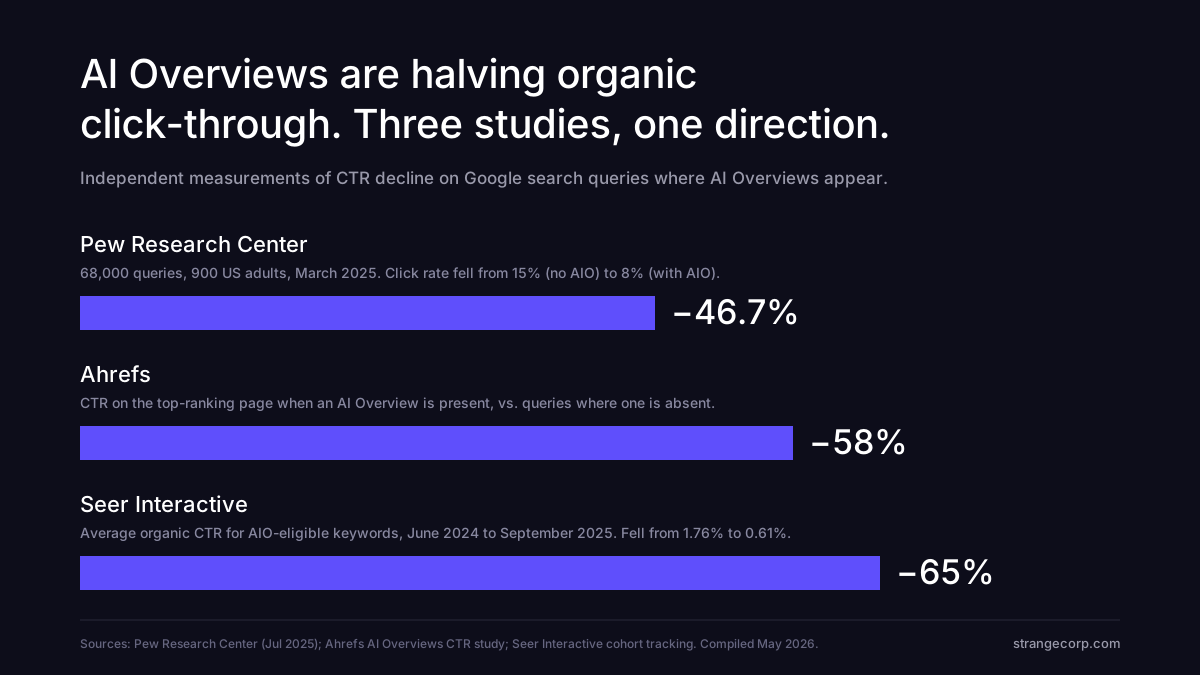
These figures are noisy and study-dependent, but the direction is consistent and the magnitude is large. For informational queries (the "what is", "how do I", "best way to" middle of the funnel), click-through rates have approximately halved in eighteen months, and the I/O 2026 changes accelerate the trend rather than reverse it.
For commercial queries, where users still need to evaluate a supplier before they buy, the picture is much less bleak. Branded search, navigational queries, comparison searches and high-intent service queries continue to behave more like classic Search. AI Mode supplements the journey for these queries; it does not replace it.
The strategic shift, stated plainly
"SEO is dead" is the wrong framing because it implies one thing has ended. What has actually happened is that two different jobs that used to share a name have split apart.
The first job, winning attention for informational content that AI can synthesise, is structurally harder and getting harder. If your site earns most of its traffic from "what is X" and "how do you Y" articles, plan for that traffic to keep falling on the trajectory the studies above describe.
The second job, being the source AI systems cite, the brand the agent shortlists, the site the high-intent visitor actually lands on, is structurally more valuable, and is now the centre of what good SEO looks like.
The difference between the two explains why we have been telling clients, since well before I/O 2026, that volume-led content programmes were a poor investment and that the budget belonged elsewhere.
Where the budget belongs
Five places, none of them new for our clients.
The first is technical foundations that AI systems can actually read. Clean HTML, semantic structure, accurate schema, fast pages, stable infrastructure, working canonicals. AI Overviews and agents preferentially synthesise from sources they can parse confidently. Core Web Vitals, schema and tracking integrity were "best practice for ranking" two years ago; they are now the price of being readable to the systems that decide whether you appear at all.
The second is decision-stage content, not informational content. Comparison pages, pricing context, methodology, real client outcomes, FAQ blocks that answer the questions a buyer asks at the point of choosing. AI systems still need somewhere to send a user who has done the synthesis and now needs to commit. If your site is mostly top-of-funnel, you will lose visibility. If your site is mostly bottom-of-funnel and well-structured, AI Mode tends to deliver the user straight to it.
The third is entity and brand signals. AI Mode disproportionately surfaces brands it has seen referenced repeatedly in trusted contexts. PR placements, expert-authored content, podcast appearances, industry citations, real author bylines, accurate Wikidata entries: the things we have always called brand equity, now load-bearing for retrieval. Founders being visible matters more than a company blog publishing a post a week.
The fourth is tracking and attribution that survive an AI-first journey. Most analytics setups were architected for a "search → click → site → convert" flow. AI Mode breaks this in two places: the user arrives via fewer, longer, higher-intent sessions, and a meaningful share of the journey happens off-site, inside the AI conversation. If your tracking still attributes leads to "organic" without distinguishing AI-referred traffic, conversational sessions or branded-search uplift from underlying AI exposure, you are not seeing the full picture. First-party data, GA4 properly configured, Consent Mode v2, and explicit AI-referrer segments are no longer optional.
The fifth is genuinely expert content where it lives, not where it scales. AI commoditises the average. It does not commoditise specifics: a real CRO test, a before-and-after with numbers attached, a platform-decision write-up with the trade-offs named. We have been recommending this kind of content for eighteen months because it builds entity signals and earns commercial inbound. Both of those are now the actual mechanism of search visibility, not a side benefit.
What is conspicuously not on this list: publishing more AI-generated blog posts to "feed the machine". What it needs from your site is content the model cannot generate itself: specifics, first-party evidence, real outcomes.
What we recommend auditing this quarter
We would split the work into four passes.
Pass one is technical readability. Can AI systems crawl and parse the site cleanly? Is schema present and correct? Are Core Web Vitals in the green? Is internal linking pointing at the pages we want surfaced? Are there accidental noindex tags, canonical mistakes or broken sitemaps quietly costing visibility?
Pass two is content fit. Where on the funnel does the site's traffic come from, and is that traffic worth defending? For most B2B and high-consideration clients, somewhere between a third and a half of existing organic content is informational filler that was earning impressions but no commercial value. It can be consolidated, redirected or retired without losing anything that generates revenue.
Pass three is tracking integrity. Is the site measuring what is actually happening? Branded versus non-branded splits. AI referral segments. Events firing accurately. Lead-source attribution that can survive longer, multi-touch journeys.
Pass four is visibility outside Google. AI Mode aggregates citations from across the open web. Industry press, expert directories, podcast transcripts, partner sites, Wikidata entries: the bits AI Mode pulls from when shortlisting suppliers. For most clients, this is the most under-invested area on the site map even though it is increasingly the leading indicator.
This is the audit we now run for new clients before any retainer work begins.
What this is not
For clarity, none of the above means the website matters less. It matters more, because the visitors who arrive are fewer and more valuable. None of it means SEO is going away. Search demand is not shrinking; click-throughs on informational queries are. None of it means AI-generated content is the answer; it is increasingly a liability. And none of it means you can opt out. AI Mode is now the default for a billion users.
It also does not mean panicking. The brands that handle this transition well will be the ones already investing in the foundations: a fast, accessible, semantically clean website, with content that demonstrates expertise, and tracking that can tell the team what is actually working.
A free visibility and performance audit
For organisations that want a straight read of where their site sits in the new search landscape, we run a free, founder-delivered audit. The result is a short report you can act on.
There is no follow-up sales process and no obligation. It is one of the few audits we can do that AI cannot.
Book a 30-minute call with one of our Directors and we will walk through the findings together.
Frequently asked questions
What is Google AI Mode? Google AI Mode is the conversational, AI-first search experience that runs alongside, and increasingly in front of, classic Search. As of I/O 2026 it has one billion monthly users, runs on Gemini 3.5 Flash by default, and is available in 200 countries and 98 languages with no subscription required.
Is SEO dead? No. The work of being discoverable, citable and trustworthy to search systems, both classic Google and AI Mode, is more important, not less. What is changing is which kinds of SEO work pay back. Volume-led informational content programmes are losing value rapidly. Technical SEO, structured data, entity authority, decision-stage content and tracking integrity are increasing in value.
How much has organic click-through rate fallen with AI Overviews? Independent studies give different numbers depending on methodology. Pew Research found a 46.7 per cent relative decline in click-through rate when an AI Overview is present (8 per cent versus 15 per cent), based on actual browsing behaviour across 68,000 queries. Ahrefs found a 58 per cent lower CTR on the top-ranking page when an AI Overview is shown. Seer Interactive found a 65 per cent decline in average organic CTR for AI-Overview-eligible keywords between June 2024 and September 2025. The direction across studies is consistent and the magnitude is large for informational queries.
Does my business need a different SEO strategy now? Probably not a different strategy, but almost certainly a different mix. The work that still pays back (technical foundations, decision-stage content, schema, entity signals, tracking integrity) is the same work we have been recommending for the last year. What changes is the budget weighting, away from volume-led informational content and toward fewer, deeper, more authoritative assets.
Should I publish more AI-generated content to compete? No. AI systems already have access to the output of AI systems. What they value from your site is content they cannot generate themselves: specific, expert, evidenced, first-party material. Publishing more average content is increasingly a way to dilute the signals you actually want to send.
How will information agents change purchasing behaviour? Information agents launch in summer 2026 for AI Pro and Ultra subscribers initially. The example Google gave was apartment hunting, but the same pattern applies to any high-consideration purchase where a user is willing to delegate ongoing monitoring to an AI. The implication is that AI will increasingly shortlist suppliers before a human visits any website. The brands AI shortlists are the brands AI has seen cited as authoritative across the open web.
What is the single most important change to make this quarter? For most sites we look at, it is tracking and attribution. Most analytics setups were designed for a click-driven funnel and no longer accurately represent how users find and evaluate the business. Without clean data, no other decisions can be made confidently.
Do these changes affect all websites equally? No. Sites that earn most of their traffic from informational, top-of-funnel content are most exposed. Sites with strong brand search, commercial intent traffic, and well-structured decision-stage content are far better insulated. Charities, professional services, B2B, and high-consideration ecommerce sites tend to fall into the second group, provided their foundations are sound.
About the author

Jon Boston is Co-Founder and Technical Director of Strange, a digital marketing and web development agency based in Bournemouth and Bristol. He has spent more than 25 years building, replatforming and optimising commercial websites for charities, B2B and professional services, and direct-to-consumer brands across the UK. He writes about web performance, platform decisions and the disciplines that make websites earn their place.
Let's chat. Tell us a bit about your project.
If you prefer to speak with someone, call 01202 203160 or if you'd like to book a 30 min meeting to see if we can help just let us know and we'll arrange a call with one of our Directors.